

5 Warning Signs Your Refractory Lining May Be Failing
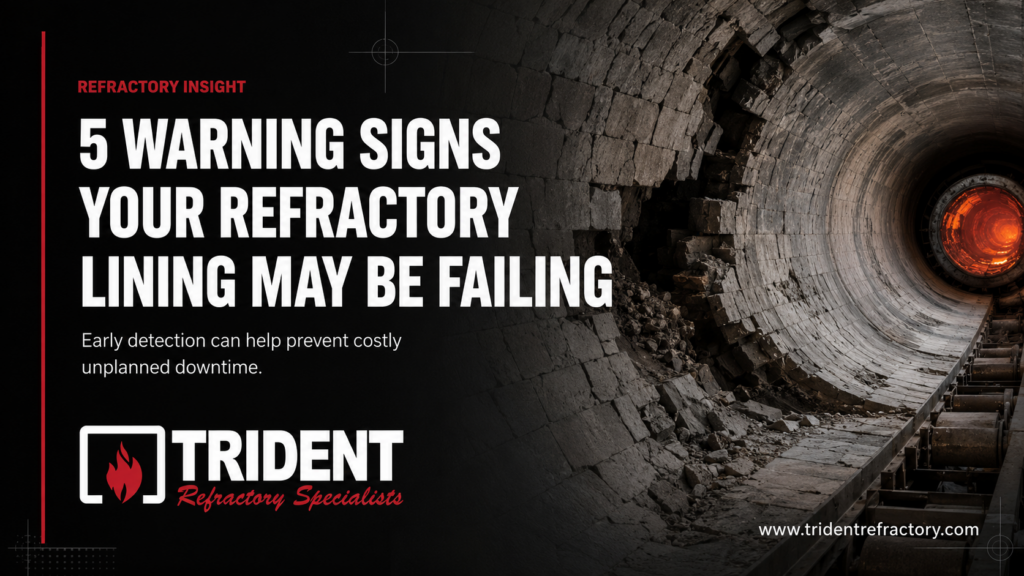
Refractory lining failure can lead to heat loss, equipment damage, safety risks and costly unplanned shutdowns. Fortunately, refractory linings rarely fail without displaying warning signs.
Industrial furnaces, kilns, boilers, reactors and other high-temperature equipment depend on refractory linings to protect their steel shells from extreme heat, chemical attack, abrasion and mechanical wear. When the lining begins to deteriorate, identifying the problem early can give maintenance teams time to plan the necessary refractory repairs.
Here are five warning signs that may indicate your refractory lining is failing.
What Causes Refractory Lining Failure?
A refractory lining is designed to withstand severe operating conditions, but it does not last indefinitely. Its service life depends on the lining design, refractory material, quality of installation and conditions inside the equipment.
Common causes of refractory lining failure include:
- Rapid heating or cooling
- Frequent shutdown and start-up cycles
- Chemical or slag attack
- Mechanical impact and abrasion
- Incorrect refractory material selection
- Poor installation
- Inadequate expansion allowances
- Damaged refractory anchors
- Moisture entering the lining
- Operating temperatures exceeding the lining design
- Changes in fuel, feedstock or process conditions
Refractory failure is often caused by a combination of factors. This is why the visible damage and its underlying cause should both be investigated.
1. Unusual Hot Spots or Rising Shell Temperatures
Unusual hot spots or an increase in external shell temperature can indicate that the refractory lining is no longer providing sufficient thermal protection.
Hot spots may develop when the lining becomes thinner, cracked, damaged or displaced. They can also point to open joints, insulation gaps or areas where refractory material has fallen away.
Infrared thermography is commonly used to monitor external shell temperatures while equipment is operating. Thermal scanning can identify areas of heat loss that may not be visible during a standard external inspection.
Maintenance teams should compare thermal readings against:
- Previous inspection results
- Normal operating temperatures
- The equipment’s established temperature limits
- Other comparable areas of the equipment shell
A hot spot does not automatically confirm the exact type of refractory damage. However, a hot area that is expanding or becoming progressively hotter requires investigation.
2. Cracking, Spalling or Refractory Material Loss
Cracking is one of the most recognisable signs of refractory lining failure.
Minor surface cracks may occur as refractory materials expand and contract during heating and cooling. The concern arises when cracks become wider, deeper or more widespread.
Spalling occurs when sections of refractory material crack, flake or break away from the lining surface. This can expose the layers behind the hot face to temperatures and operating conditions they were not designed to withstand.
Warning signs include:
- Deep or expanding cracks
- Flaking refractory surfaces
- Loose sections of castable
- Exposed refractory anchors
- Visible reduction in lining thickness
- Refractory debris inside the equipment
- Sections of lining pulling away from the shell
Cracking and spalling may result from thermal shock, mechanical stress, chemical attack, incorrect material selection or improper installation.
Localised damage may sometimes be repaired before it spreads. Extensive cracking or material loss may require partial replacement or a complete reline.
3. Loose, Displaced or Falling Refractory Bricks
Loose or displaced refractory bricks can indicate that the structural stability of the brick lining has been compromised.
Brick linings depend on correct installation, suitable expansion allowances and adequate support. When bricks begin moving, leaning, bulging or falling, the surrounding brickwork may also be affected.
Possible causes include:
- Inadequate expansion joints
- Thermal cycling
- Mortar deterioration
- Movement of the equipment shell
- Excessive mechanical loading
- Loss of support
- Incorrect brick installation
- Operating temperatures above the design limit
A single displaced brick can alter the load distribution within the surrounding lining. If the movement continues, a larger section may loosen or collapse.
Visible movement, bulging or loss of refractory brickwork should be assessed by an experienced refractory specialist.
4. Increased Fuel Consumption and Heat Loss
A damaged refractory lining may allow more heat to escape through the equipment shell. The system may then require additional fuel or energy to maintain the required process temperature.
Possible signs of declining thermal efficiency include:
- Higher fuel consumption
- Increased energy costs
- Longer heating periods
- Difficulty maintaining operating temperatures
- Uneven temperature distribution
- Reduced production efficiency
- Increased external shell temperatures
Higher fuel consumption alone does not prove that refractory lining failure has occurred. Burner problems, process changes and other mechanical issues can produce similar symptoms.
However, when increased energy use occurs alongside hot spots, visible lining damage or changes in equipment performance, the refractory system should be included in the investigation.
Monitoring operating temperatures and energy consumption over time can help maintenance teams identify gradual changes before they become severe.
5. Changes in Equipment or Process Performance
Changes in furnace, kiln or boiler performance may provide an early indication of refractory deterioration.
Operators may notice:
- Longer heat-up times
- Unstable process temperatures
- Cold areas inside the equipment
- Changes in airflow or combustion
- Reduced production output
- Refractory debris contaminating the process
- Unusual sounds during operation
- Changes in the equipment’s internal dimensions
These symptoms may be linked to refractory deformation, lining loss, material build-up or structural movement. They may also be caused by other operational or mechanical problems.
For this reason, changes in equipment performance should be recorded and investigated rather than used as a standalone diagnosis.
Operators often notice changes before extensive refractory damage becomes visible. Their observations can therefore provide valuable information during a refractory inspection.
Why Early Detection of Refractory Failure Matters
Ignoring the early warning signs of refractory lining failure can allow a manageable repair to develop into a serious equipment problem.
Advanced refractory deterioration may result in:
- Damage to the steel shell
- Excessive heat loss
- Reduced thermal efficiency
- Unsafe external shell temperatures
- Process contamination
- Unplanned production shutdowns
- Longer repair periods
- Higher demolition and replacement costs
Routine inspections, thermal scanning and operating-data reviews can help identify changes in the lining before they become critical.
Inspection findings should be documented and compared over time. This makes it easier to distinguish normal surface wear from progressive refractory deterioration.
What Should You Do if You Suspect Refractory Lining Failure?
If warning signs are identified, the equipment and operating conditions should be assessed by a suitably experienced team.
The correct response will depend on:
- The type of equipment
- The refractory lining design
- The location and extent of the damage
- Current operating temperatures
- Process conditions
- The condition of the steel shell
- The remaining planned operating period
Depending on the findings, the recommended solution may involve a localised refractory repair, partial lining replacement or complete relining.
Repairing only the visible damage without identifying its cause can allow the same failure to develop again.
Refractory Inspection, Repair and Installation Support
Trident Refractory Specialists provides refractory demolition, installation, repairs, inspection support and material supply for high-temperature industrial equipment.
Our teams support planned shutdowns, maintenance projects and emergency refractory breakdowns across South Africa and surrounding regions.
If you have identified hot spots, cracking, loose brickwork or other signs of refractory lining failure, contact Trident Refractory Specialists to discuss your equipment and maintenance requirements.
Telephone: 031 785 2100
Email: info@tridentrs.co.za
Website: www.tridentrefractory.com
Offices: KwaZulu-Natal, Western Cape and North West
Frequently Asked Questions About Refractory Lining Failure
What is the most common sign of refractory lining failure?
Common signs include abnormal shell temperatures, hot spots, cracking, spalling, loose brickwork and visible refractory material loss. The exact warning signs depend on the equipment and type of lining installed.
Can a damaged refractory lining be repaired?
Localised damage can often be repaired if it is identified early and the surrounding lining remains stable. More extensive deterioration may require partial replacement or a complete reline.
How are refractory hot spots detected?
Infrared thermography can be used to measure external shell temperatures and identify areas of abnormal heat loss while equipment is operating.
How often should a refractory lining be inspected?
Inspection frequency depends on the equipment, process conditions, operating temperature, lining history and shutdown schedule. Regular monitoring should form part of the site’s preventative maintenance programme.
What happens if refractory lining damage is ignored?
Continued operation with a damaged lining can increase heat loss, expose the steel shell to excessive temperatures and result in more extensive refractory failure or an unplanned shutdown.